Jumping hour or wandering hour: which complication is right for you?

For decades, most watches displayed the time in the same way: one hand for the hours, another for the minutes, sometimes a third for the seconds.
Yet, some watchmakers have always sought to break free from this traditional display.
Not to unnecessarily complicate the time display, but to offer a different experience. A more mechanical, more visual, or sometimes more poetic way of interacting with time.
Among the complications that most fascinate independent watch enthusiasts, two hold a special place: the jumping hour and the wandering hour.
Both reinvent the way we read time.
Both offer a unique mechanical spectacle.
But their philosophies are radically different.
One prioritizes instantaneous precision and legibility. The other transforms the passing of the hours into a continuous and almost hypnotic movement.
So, which one is right for you?

Why are enthusiasts looking for something other than traditional needles?
Mechanical watchmaking is experiencing a fascinating period.
Never before have enthusiasts had access to so many independent creations, innovative micro-brands, and original horological concepts. This new generation of brands no longer hesitates to challenge codes established for centuries.
This evolution has profoundly changed collectors' expectations.
Today, owning a watch is no longer simply about knowing the time.
After all, a smartphone does that perfectly well.
A mechanical watch has become an emotional object. An object chosen for its history, its personality, and the sensations it evokes every day.
It is precisely in this context that alternative displays are experiencing a new golden age.
Wandering hours, jumping hours, rotating discs, and satellite displays offer something a classic watch cannot: surprise.
Every glance at the dial becomes a discovery. Every time change becomes a mechanical event. And it is this emotion that largely explains the current enthusiasm for these complications.
When an enthusiast first discovers an ANGLES Orbitron, a PowerPanda Hivecore, or an OLTO-8 Chrono Gate, the reaction is often the same:
"How do you tell the time?"
This question is precisely what makes these watches so appealing.
They invite us to slow down, observe, and interact with time in a different way.
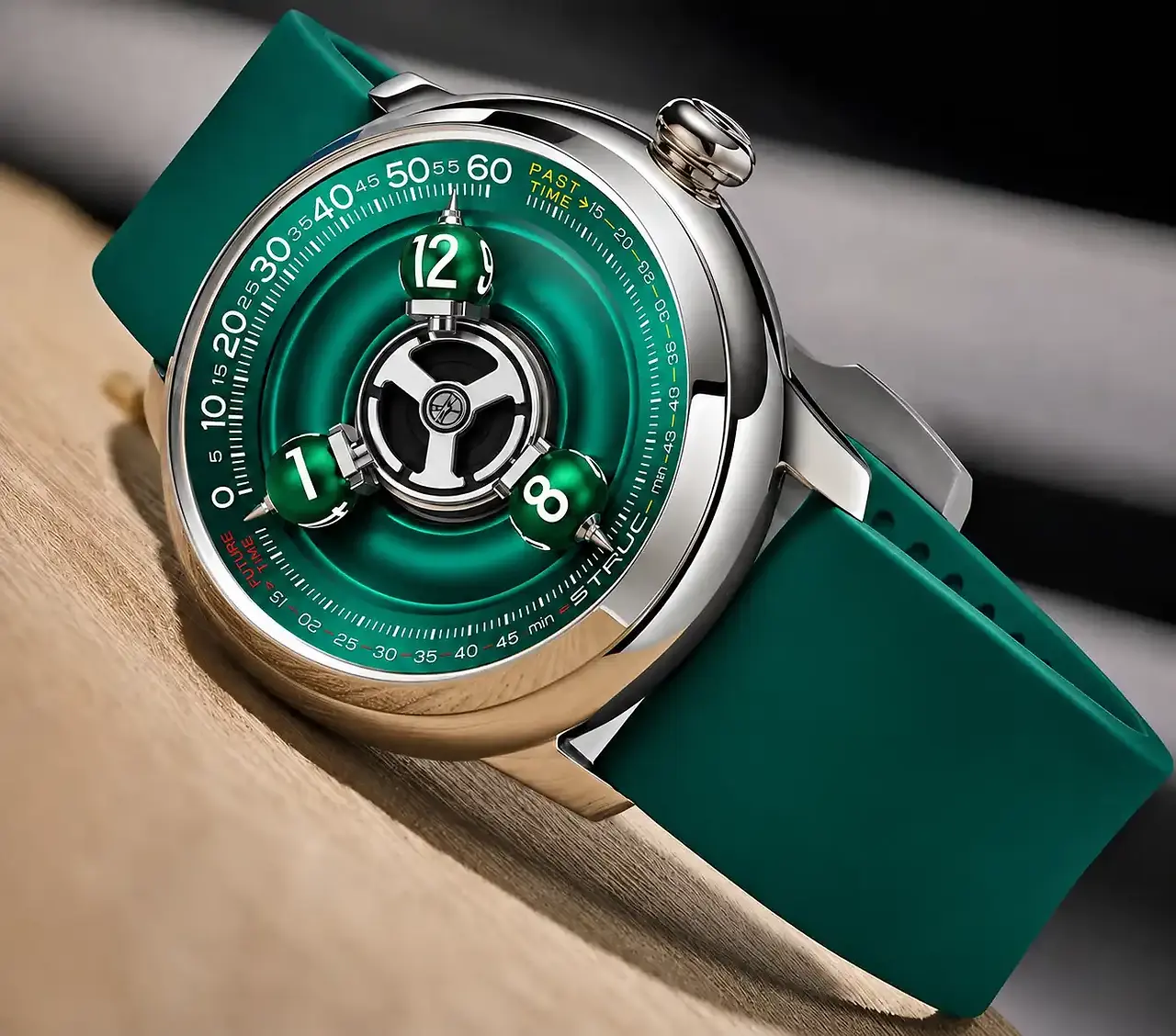
Struc Time Shuttle 
Angles The Chronoform System
The jumping hour: precision in its most spectacular form
At first glance, a jumping hour watch often seems simpler than a traditional watch.
Yet, its operation is far more complex.
Unlike an hour hand that slowly moves throughout the day, the jumping hour displays the time in a dedicated aperture. When sixty minutes have elapsed, the numeral changes instantly to display the next hour.
The transition is crisp, precise, and particularly satisfying to watch. This mechanism produces a unique sensation.
The time appears and then disappears in a single movement.
No transition.
No hesitation.
Just a perfectly orchestrated jump.
It is this instantaneity that so appeals to enthusiasts of alternative displays.
The jumping hour also has a clear advantage: its legibility.
A simple glance is all it takes to know the exact time.
The numeral appears clearly in its aperture, without needing to interpret the position of a hand. This apparent simplicity explains why this complication is regularly associated with modern and minimalist designs.
At Whatimisit, several models perfectly illustrate this philosophy.
The ANGLES Disc One reinterprets the jumping hour with a particularly original disc display, while the OLTO-8 Chrono Gate offers a contemporary interpretation where mechanical architecture and legibility coexist harmoniously.
These watches often appeal to enthusiasts who appreciate technical objects, modern lines, and intelligent horological solutions. They offer a different, yet immediately understandable, way of telling time.
The jumping hour is thus often chosen by those who want to think outside the box without sacrificing ease of everyday use.

The Wandering Hour: When Time Becomes a Mechanical Spectacle
While the jumping hour impresses with its instantaneous precision, the wandering hour fascinates with its movement.
Here, the hour doesn't appear in a window. It travels. It evolves slowly with the passing minutes before giving way to the next in a perfectly orchestrated mechanical ballet.
The principle is as ingenious as it is elegant.
Several discs or satellites bear the hour numerals. One of them travels along a graduated arc indicating the minutes. Once its journey is complete, it yields to the next satellite, which takes over for the following hour.
The first time you observe this mechanism in action, it's difficult to remain indifferent. Unlike a traditional watch, whose workings quickly become invisible to the eye, the wandering hour naturally attracts attention.
You find yourself looking at your watch simply to observe the movement of the satellites.
This is probably what explains the particular attachment that many collectors develop for this complication.
The wandering hour doesn't just tell time.
It stages it. Each hour change becomes an event. Each rotation contributes to the spectacle.
This more emotional approach to watchmaking has allowed several independent micro-brands to push the boundaries of traditional design.
Among the most iconic examples, the ANGLES KOI-5 has become a benchmark in its genre. Its original display and intuitive readability have captivated many enthusiasts worldwide.
The ANGLES Orbitron takes the concept even further with its three-dimensional titanium satellites that appear to float above the dial. Reading the time becomes almost secondary as the captivating mechanical animation draws the eye.
Atowak's creations also follow this philosophy, offering modern and spectacular interpretations of the wandering hour.
They all share a common thread: they transform a mundane gesture — checking the time — into a complete horological experience.
This is why enthusiasts who discover wandering time for the first time often find it difficult to return to more conventional displays.

Nubeo Tri Star Orbit 
Lume Angles The Chronoform System 
Olto-8 King jade Green
Jumping hour or wandering hour: two very different philosophies
At first glance, these two complications seem to pursue the same goal.
They both aim to move away from traditional hands. Yet, their personalities are radically different.
The jumping hour prioritizes the present moment.
The information appears instantly.
The reading is direct, quick, and precise.
It often appeals to enthusiasts who appreciate clean designs, ingenious mechanisms, and elegant horological solutions.
The wandering hour takes an almost opposite approach.
It prioritizes movement.
Time doesn't appear suddenly.
It evolves gradually before the wearer's eyes.
The experience becomes more contemplative.
More vibrant.
More emotional, too.
This difference explains why two enthusiasts might be drawn to completely different complications despite a shared interest in independent watchmaking.
Some primarily seek an original yet effective time display. Others want to be surprised every time they glance at their watch.
Neither of these approaches is superior. They simply cater to different sensibilities. And that is precisely what makes these complexities so fascinating. They allow each individual to find a personal way of experiencing time.
Which complication is right for you?
Choosing between a jumping hour and a wandering hour isn't a matter of performance or prestige.
Both complications are fascinating.
Both require true watchmaking expertise.
Both offer an attractive alternative to traditional displays.
The choice depends primarily on your personality and how you appreciate watchmaking.
You like technical objects and immediate readability
The jumping hour display might be just what you're looking for.
Its instant readability provides a unique satisfaction. A simple glance is all it takes.
The information appears clearly, without any ambiguity. Contemporary design enthusiasts often appreciate this direct and efficient approach.
Models like the OLTO-8 Roto or KRONOZURI Elemental Stones perfectly illustrate this philosophy. Their display immediately catches the eye while maintaining excellent legibility for everyday wear. These watches often appeal to enthusiasts looking for a distinctive piece that's also easy to wear every day.
You enjoy watching the mechanics come to life before your eyes.
The wandering hour possesses an emotional dimension that is hard to match.
Here, time seems to be in constant motion. The watch almost becomes a living object. Each hour change is a small mechanical performance. Each rotation of the satellites contributes to the spectacle.
Collectors who appreciate animation, three-dimensional architecture, and unusual displays often fall under the spell of this complication.
Creations like the ANGLES KOI-5, the Orbitron, or certain Atowak timepieces perfectly illustrate this more contemplative approach to watchmaking.
We no longer look at our watches simply to tell the time.
We look at them because they are fascinating.
Are you looking for a piece that sparks conversation?
In this case, both complications are excellent candidates.
A jumping hour watch is immediately intriguing.
A wandering hour watch is a lasting source of fascination.
In both cases, questions quickly arise.
"How does it work?"
"How do you tell the time?"
"I've never seen anything like it before."
For many enthusiasts, this is precisely what makes these watches so appealing. They possess a strong personality in a world where many creations end up looking alike.
You're a beginner in independent watches.
The jumping hour is often an excellent entry point. It remains intuitive while offering a different experience from a traditional watch.
The jumping hour sometimes requires a few minutes of adjustment, but it quickly rewards its owner with a continuous mechanical spectacle.
The truth is, there's no wrong choice. Many collectors start with one complication before discovering the other a few years later.
And many end up appreciating both for entirely different reasons.

Atowak Spaceship 
Angle the Triscope
Why are these complications experiencing a new golden age?
For a long time, jumping hours and wandering hours were primarily reserved for a few high-end manufacturers or exclusive creations. Their technical complexity naturally limited their widespread adoption.
The emergence of micro-brands in the watchmaking industry has profoundly changed this situation. Independent players like ANGLES, Atowak, and PowerPanda have demonstrated that it is possible to offer original complications at much more accessible prices than before.
This new generation of brands is not looking to replicate what already exists. It seeks to surprise. To experiment. To offer a different vision of mechanical watchmaking.
This is precisely what attracts so many enthusiasts today. In a market where traditional watches still hold a dominant position, these creations offer a refreshing alternative. They remind us that watchmaking is also a playground for engineers, designers, and dreamers. And it is probably for this reason that interest in alternative displays continues to grow.
Collectors are no longer simply looking for a beautiful watch.
They are looking for an experience. An emotion. A story to tell.
And few complications fulfill this mission as well as the jumping hour or the wandering hour.
Conclusion
The jumping hour and the wandering hour ultimately share the same goal: to transform our relationship with time.
One prioritizes instantaneous precision and legibility. The other stages the passage of hours through a captivating mechanical ballet.
Two different approaches. Two sensibilities. One shared passion for creative watchmaking.
Whether you are drawn to the technical elegance of a jumping hour or the mechanical poetry of a wandering hour, these complications remind us that a watch can be much more than a simple timekeeping instrument.
It can become a complete experience. And it is precisely this vision that the most daring independent brands are championing today, offering creations capable of surprising, enchanting, and restoring a touch of magic to time.
FAQ: The essentials in 30 seconds
1. What is the difference between a skipping hour and a wandering hour?
The jumping hour displays the hours in a window with an instantaneous change on each hour. The wandering hour uses satellites or moving discs that travel along a graduated arc of minutes before giving way to the next hour.
2. Is a watch with wandering time difficult to read?
Not at all. A short adjustment period is usually all it takes. Once you understand the principle, reading the time becomes intuitive while offering a much more visual experience than a traditional watch.
3. Where can I find watches with jumping or wandering hour features?
Long reserved for a select few high-end manufacturers, these complications are now offered by several innovative independent brands. Whatimisit selects models with jumping hours, wandering hours, and other atypical displays from brands renowned for their horological creativity.
4. What complication should I choose for my first, unusual watch?
The jumping hour is often an excellent entry point thanks to its immediate readability. Wandering hours appeal more to enthusiasts seeking a more spectacular and original mechanical experience.
5. Why do micro-brands use so many of these complications?
Independent micro-brands enjoy considerable creative freedom. They explore alternative displays to offer watches that differ from traditional models and provide a more original watchmaking experience.
Read also
By Pascal — Whatimisit
Co-founder & Curator


Comments